Welcome to Hill Country Herbalist

Sunday, December 9, 2012

December Gardening in the Texas Hill Country: Beta Carotene & Vitamin C Power heading into Winter

This has been an amazingly warm fall and winter.  Typically we receive our first frost (just enough to kill everything back) by late October.  This year, we are heading into the second week of December without one damaging freeze yet! Incredible.  Well, the clock is ticking.....we are gearing up for our first deep freeze this week.  That means I've been very busy in the garden trying to capture and harvest every last drop of the late summer and fall garden. I've carried armfuls of fruits and veggies inside the house and there's so many foods I'm excited to share with you today!

First, I want to share one of my most favorites: The Romeo Carrot.  This carrot grows to be three inches or shorter and is just the same in diameter.   They are popping up from the earth on their own letting me know they are ready to be enjoyed!


I planted them in late summer/early fall and they mature pretty quickly. I must say, these are the sweetest and tastiest carrots I've ever had.  I peeled them and sliced them and gently sauteed them with a little butter, salt, pepper, and freshly ground nutmeg.  Oh they are so tasty! I was eating them with my fingers hardly able to wait to plate them up!

I also chopped fresh parsley from the garden and added them to the sauté at the end.  So sweet and savory.  I will certainly be enjoying these again and again. 

As I gobbled them down, I started wondering if there was a relationship between the primarily orange and reddish foods coming out of the garden as we head into winter.  Exploring my curiosity, I noticed a lot of the food coming out of the garden is packed full of beta carotene and vitamin C. 

Beta carotene is a powerful antioxidant and full of age fighting properties.  It also boosts the immune system and helps improve night vision.  With the days growing shorter, we sure have a lot more night in our lives and eating fresh organic carrots is not a bad thing if you ask me.  I need all the help I can get when walking in the dark checking on plants and the greenhouse not to mention driving in the dark at only 6pm!

Peeled organic carrots from the garden: I love all the different shapes and sizes!
Before it freezes this week, I went ahead and harvested every single bell pepper, fig, pumpkin, tomato and herb I knew would be damaged by the cold temperatures. Did you know all bell peppers are a good source of Vitamin C? Yellow and red are higher, but even the green bell pepper is a great source of Vitamin C!  So all these wonderful fresh foods sitting on my kitchen counter are great sources of beta carotene and vitamin C! What a blessing from mother earth. 


Heading into winter, it's important to feed and nourish our bodies properly with fresh sources of vitamins and minerals.  Our immune systems will certainly get a work out in the months ahead.  Last night, I made a fresh salad with sliced tomatoes and bell peppers with a squeeze of Meyer lemon juice and a dash of sea salt.  A tart and savory treat.  The combined juices could have been a specialty juice blend all its own!

Parsley (Petroselinum crispum) thriving in the December garden
Parsley has been used as an after dinner herb, both pallet cleansing and bad breath reducer.  Parsley is also a great source of potassium, vitamin A, vitamin C, calcium, magnesium, and niacin. 

Parsley is also a good blood cleansing herb and can help rid the body of toxins. It's so easy to eat and versatile. I like to make cuttings from the fresh sprigs and keep in a slender vase in the kitchen. It keeps very well and stays fresh in water....and best thing is you can use the sprigs throughout the weeks in your nightly cooking.  Chop finely and dress up any weeknight meal for a gourmet treat :)

Tonight, after I came home from a long day at work - I saw the abundance of tomatoes, peppers, parsley, sage and Swiss chard on my kitchen counter.  I also had grass fed ground beef waiting to be introduced into a meal tonight, too.  I had no idea what I was going to do when it just was so obvious I had no other choice but to make it.  Stuffed bell peppers with sauteed tomato, beef, garlic, parsley and sage. 
I started by browning the grass fed beef along with one seeded habanero pepper (I have so many I always try and use them here and there).  I took the seeds out to keep the flavor but not the heat.  Fresh habanero is so sweet and adds complexity to the dish.  It's a wonderful stimulating herb for your nose, taste buds, and circulatory system. 
Next, I drained any excess fat and added about two cups chopped tomato.  After the tomatoes started to reduce, I added one minced garlic clove, two sage leaves, 1-2 leaves chopped Swiss chard leaves,  and freshly chopped parsley (about two tablespoons).  While cooking I halved and seeded 4 bell peppers.  Once everything was simmering and reducing in the skillet, I gently added the halved peppers facing up just to gently steam them.  After a couple minutes of steaming the peppers, I removed them and plated them.  I then stuffed them with the ground beef sauté.


I love this since it was made all in one skillet.  No need to get overly fancy for a Monday night - but it really hit the spot....home cooked vitamin packed goodness but not all the fuss. 

Next time, I want to share with you how I made a wonderful figgy treat! It's a sticky, delicious, gourmet, must-have dessert you can make right at home :)

Until nextime, HCH


Saturday, October 6, 2012

What's Blooming and Fruiting in the Hill Country Garden this Fall!


October is one of the most beautiful and productive months in the Texas Hill Country.  Next to early spring, this is an eye popping time of year.  The garden is abundant with blooms and fruits and veggies - perfect for garden to table lifestyles.  Shown here is a beautiful Okra bloom.  Our Okra was over 6 feet tall this year! Honey bees are active, as are cardinals, hummingbirds and lady bugs.  Lots of lady bugs! There are so many pictures I want to share with you, I'm going to narrate less in this blog and just show you through pictures.  So here we go, come stroll through the garden with me!
Lady Beetle on an Okra leaf
Passiflora incarnata
Passion Flower vine growing on the garden fence.  We admire this gorgeous flower daily.

Echinacea - still blooming (but now fading) in the garden

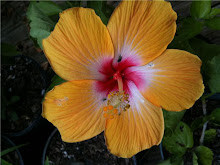
Orange Hibiscus from one of the last cuttings my grandfather made


Belinda's Dream is budding and blooming.  Exciting blooms ignite visual senses while the fragrance sweetens the air

Souvenir de la Malmaison is a gorgeous bloom.  I love picking this bloom along with other roses in the garden and infusing in apple cider vinegar for a skin tonic

Zinnias 4 feet tall!

Cayenne Pepper.  Turns out this is my favorite peppers of all peppers.  Incredible flavor! I add to rice, meats, soups, just about anything -


Habanero, Serrano, and Cayenne peppers
Serrano overload! No doubt I'll be dehydrating these and grinding them into herbal spicy powders

Figs! Happily harvesting figs daily.  We love them!

Meyer Lemons are getting larger and changing from green to yellow.  They should be ready late next month. 
My Mullein Friend!! I love Mullein - happy fuzzy soft leaves make me smile each time I walk by

Passion Flower at dusk


Briar with Mexican Hat wildflower
 
Well, that's a quick update...so much more - I will share in another post.  In the meantime - let's take a cue from Briar and head outside and smell the crisping autumn air and enjoy the fall flowers!!

Wednesday, September 26, 2012

Skin Loving Fall Herbs: Pumpkin Seed Oil Sugar Scrub!

 Happy Fall!! What an amazing time of year ~ It has to be my most favorite with the weather cooling and the leaves falling....ahhh.....

Since I've returned from northern Arizona and the Medicine of the People Conference, I've found the garden swollen with ripening tomatoes, peppers, pumpkins, passion flower fruit, figs, rose hips and so much more!

The fall weather has inspired me to make a special Pumpkin Harvest Sugar Scrub with omega rich pumpkin seed oil, skin smoothing and plumping cinnamon, skin tightening and lightening nutmeg, and organic sugars and citrus.  I've been using this fantastic scrub daily and love the intoxicating smell ~ like pumpkin pie in a jar.  Life is good with this botanical blend. 


Cinnamon powder can enhance skin care blends to add anti-inflammatory properties as well as help calm down acne prone skin.  It also has a plumping action by stimulating and drawing blood and oxygen to the skin, essentially reducing the appearance of fine lines and wrinkles. 

Nutmeg is also a skin hero.  Like cinnamon, nutmeg can be added to milk or honey for a simple anti-inflammatory skin care mask.  I've introduced nutmeg to my facial and body sugar scrub not only for its anti-inflammatory benefits but for its astringent and antibacterial benefits, which helps heal acne scars.  Nutmeg also adds a grounding element to the fragrance of the scrub.  Combined with cinnamon, pumpkin seed oil and a hint of clove - this scrub is fall in a jar. 

Pumpkin seed oil is a skin's best friend seeing that it is rich in omega fatty acids, zinc and vitamins A, C, & E.  When applied topically, it helps regulate the production of skin sebum. So, if you produce to much - it will help your skin produce less and if you produce too little (as in dry skin) it will help moisturize and encourage your skin to produce more. Also, like our friends cinnamon and nutmeg, pumpkin seed oil is also an anti-inflammatory, which helps heal troubled skin! I think we are seeing a trend here!


So, for a simple facial for troubled skin or for skin needing rejuvenation after a long summer you can simply use a few ingredients right out of your pantry to help excite your skin this fall season.  Try one part honey to half part cinnamon (or half part nutmeg) and apply to face for a great skin plumping and healing experience. 

You can also substitute honey for actual pumpkin scraped out of a fresh pumpkin (or canned).  That is wonderful! No fresh pumkin pulp? No problem! Try one part milk with half part cinnamon (or one half nutmeg)...that works beautifully, too. 

Pumpkin seed oil can be enjoyed internally and externally for super beauty benefits.  Try drizzling on salads or applying directly on face a few times per week.  It's a wonderful addition to your fall beauty regime. 

Or, you can celebrate fall with a handmade facial scrub - like the one I made!  Here's a picture of the lovely scrub I've been over indulging in these days.  Smells delightful - it is confusing as it smells edible and delicious.  Your skin will crave and rave after each application :)


How have you been celebrating our new fall season? I'd love to hear from you!
Until next time, wishing you health and happiness - HCH


Monday, September 17, 2012

Traditions in Western Herbalism: Medicine of the People Conference Mormon Lake, Coconino AZ


Just returned from Traditions In Western Herbalism: Medicine for the People Conference held at Mormon Lake in Coconino, Arizona. The 3-day conference focuses on sharing the herbal knowledge of teachers, healers, practitioners and rediscovering the nearly lost practice of appreciating, understanding and utilizing the healing plants that grow all around us. The conference is organized by Jesse Wolf and Kiva Rose (www.HerbalResurgence.org) who promote a supportive and lively venue to learn about native plants as well as the importance of plant conservation, bioregionalism, how to run a clinical practice and celebrating the diverse traditions, practice, culture and the art of folk herbalism. Here, you greet old friends and make new friends in the comfort of like minded plant conservationists. 

 
Herb-husband,our friend and body healer Nancy, and I flew into Phoenix and drove 3.5 hours towards our destination stopping to view the gorgeous red Sedona hills along the way.
(Here, Nancy and I pose for a quick pic in Sedona).


We checked in our cabin then registered in a beautiful light strewn wooden lodge where many herbalists around our country displayed their botanical work and gifts. Here's Nicole Telkes of Austin's Wildflower School of Botanical Medicine displaying her Texas native Cactus Lotion. The inner fillet of cactus holds many of the same beneficial properties as Aloe Vera. This is a truly special way of celebrating our Texas-native cacti.  Along with Nicole in the Healer's Market, I met Darcy Blue of Blue Turtle botanicals.  I got to know her as I purchased her Ponderosa Pine salve - perfect for drawing out items that are trapped under the skin...like the splinter I have wedged 1/3rd into my nail bed received during the trip.  I must say - it's really helping.

We started our herbal retreat with a plant walk Thursday morning with Arizona native Phyllis Hogan of Winter Sun Trading Company and Arizona Ethnobotanical Research Association (AERA).  Phillis guided our group into a circle at the foot of a hill filled with rich garden herbs and explained the importance of the 21 indigenous nations in AZ.
She reminded us of the importance of adjusting ourselves and aligning ourselves with nature before entering the plant's space. Burning a bit of Juniper to give everyone blessings we took a moment to appreciate the full circle of life.  She stressed the importance of making a personal affirmation for the positive one wants to put into the world.  Here are a few of the plants we met on our walk:

Mallow (Malva neglecta) or Cheeseweed, common mallow. Tends to grow in disturbed areas. The Yaki used it for a weak heart or heart palpitations. Mallow's leaves look somewhat like a cheese wheel and tastes like cheese. It's a mucilaginous plant and a cold root decoction is best when working with mucilaginous herbs.   A hot tea of the leaves can be made for gut health and soothes inflammation in the gut. A hair rinse can be made from the tea as well.
Chickweed (Stellaria media) was quite abundant on the hillside. In Texas, we really only see chickweed happily growing like this in early spring. You can gather fresh chickweed and juice it and drink it for wellness. Phillis said you could drink it to assist with ulceration or for burning urine. A member of our class said she uses it in tincture, tea, or poultice to assist with fibroids of the breast and uterus. She like to use a combination of chickweed and mallow oil to rub onto the skin to assist with fibroids, as well.

We also discussed Lamb's Quarters on the walk. Here's a picture of Doug Elliot with Phillis explaining the benefits of lambs quarters. He said its very high in Vitamin A and it's a tremendously healthy wild food source.  You can steam it and eat as you would a vegetable or eat raw in salads.

What a wonderful way to begin the day!


Another class I really enjoyed was Lisa Ganora's Beyond Tinctures and Oils: Extracting Herbs with Honey. 

Honey is a great medium for herbal infusions since honey does not expire.  Lisa mentioned that recently honey was found in Egypt that goes back 1,000 years and it was still good.  Honey is a perfect food and since it is so good for you, it's an ideal medium to preserve your herbs. 

During the class, Lisa made Elderberry Honey.  She recommends 1 part fresh herb to 2 parts honey. Heating the honey allows for the process to accelerate, however some prefer cold infusions to keep all the enzymes in tact and allow for a more nutritional end product.  You can make honey infusions and honey powders using your herbs.  Lisa recommends using fresh herbs when making infusions and dried finely powdered herbs for honey powders. 

Lisa's Elderberry Honey was made by heating the honey until liquid-like and then adding the Elderberries into the honey and stirring and warming on very low heat for two or more hours.  It's best to use a vitamix and break down the herb just before infusing into the honey to allow more surface area to infuse into the honey.  Honey becomes liquid like at around 130 degrees.  It's very important not to use too much heat, but just enough for the infusion to take place.  Once infused, the infusion is strained leaving behind the seeds and allowing for a clean and beautifully enhanced honey.  This can keep for years in the refrigerator. 

I'm inspired to make a wound honey powder using my lemon mint, rose petals, thyme and self heal I grow here at home.  Lisa uses rose hips, ginger, thyme in her would honey powder.  It's best not to heat the honey in a wound honey recipe in order to keep the enzymes in tact benefiting from the antibacterial properties of the honey itself.  The advantage of a powder over an infusion is you use the entire herb - nothing gets strained out.  That's why a Vitamix or an herb grinder is helpful when trying to make fine powder out of your herbs since this is going to be the state it's in when infused in your honey.

When purchasing honey, make sure it's a good quality honey.  Some honey in the supermarkets are not pure honey.  Some add corn syrup and still label their product as honey. 
Honey is warming, nourishing and moistening.  Honey can help temper an herb that is too dry or too cold (yin) when ingested alone allowing you to take in more of the herb than you could if you ingested it alone.  For example turmeric is dry.  Honey will help temper this herb when infused. 
 
Glucose oxidase is a natural component of honey.  It is made by bees when water gets introduced into the hive, such as after a rain.  When water mixes with glucose oxidase, it releases hydrogen peroxide, which kills bacteria really well.  It also pulls the water out from the honey.  Lisa said honey is good for burns and puncture wounds.  I know honey really worked wonders for me when I burned myself a while back.  It's very healing and comforting to the skin.
 
We also enjoyed listening and learning from Herbalists Charles Garcia, Paul Bergner, Sean Donahue, Howie Brounstein, 7Song, Kathleen Maier, Jesse Wolf, Kiva Rose, and many others. 
 
We ended the last day of the conference with a fast paced hike with Doug Elliot seeing the 'big picture'  of the mountains, the pine forest, birds and mammals and of course plants all along the way.  Doug is a cheerful inspiring herbalist who has a gift of knowing how everything fits together in nature, all with a song in his heart and skip in his step.  A perfect way to end our journey in this amazing bioregion. 
 
Here are some pictures taken on our own walks and hikes during our stay at Mormon Lake:

 Here's a picture of the resin from the Ponderosa Pine.  This resin can be heated and mixed with olive oil and beeswax to make a protective salve (like the salve Darcy makes).  I have a bit of resin from the forest so I plan on gently heating it and applying it straight to my fingernail to draw out the splinter wedged in my nail.  It may also help pull out the splinter once the sap hardens and gets removed from the finger.  I'm going to try this later today.  Doug Elliot also said you can chew on the resin to protect the mouth.  Its antibacterial properties helps with mouth health.  When its chewed in the mouth long enough it takes on the appearance of chewed gum. 

Mushrooms popping up from the forest floor
A bluebonnet...a little reminder of home

Mullein flowers


Holly Grape: this area's 'Mahonia'.  Here in Texas we have Agarita which also contains the beneficial yellow berberine within the woody and root parts. 


Mushroom cap - bursting out of the forest floor


Saturday, August 4, 2012

Eating From The Summer Garden: Tomatoes & Okra!

I'm really enjoying the summer bounty here in the Hill Country Garden! I've been harvesting tomatoes, okra, basil, oregano, onions almost on a daily basis....so what's one to do? Well, here's one suggestion: tomato and okra summer simmer sizzle!  Name too long? Probably, but it pretty much describes this bright and savory dish.

I start by slicing heirloom black cherry and Juliet tomatoes and add them to a bit of olive oil warming up in a pan.  Then, I add salt, pepper, garlic and fresh crushed dried basil leaves.  (I like to harvest bundles of fresh basil and hang them upside down to air dry in my kitchen window - that way I just reach over and crush the dried aromatic herbs between my hands and sprinkle all over the dish I'm cooking....it's such a treat!). 

After the tomatoes begin simmering and releasing their juices, I add fresh sliced okra. Sprinkle in just a bit more salt and let simmer for a few minutes. 


Take a look at these amazing cayenne peppers! It was so fun harvesting these red hot beauties.  I'm always looking for ways to incorporate them in the dishes I'm making.  For this dish, I sliced one pepper and added to the tomato and okra mix.  They cook into the food so easily and by only using one, the dish gets more flavor rather than heat. 


     After a few minutes, the okra begins to cook and soften.


After a couple more minutes the tomatoes and okra are simmering and enjoying each other's company.  The tomatoes naturally add a tangy bright sauce making this dish a real treat for your taste buds. 


Now that the okra and tomatoes are ready to eat! Plate the dish and grab a fork and dig in! This is a great dish all on its own and it also goes extremely well with fried or baked chicken. 

Mmmmm!  

Friday, August 3, 2012

Corn Baby!

Greetings gardeners! I've missed you....I've been weeding, pruning and watering the veggie and herb garden in this nonstop Texas heat.  It's really a  big commitment and acceptance of the crazy heat in order to garden these days...it seems the only payoff is a dripping wet shirt and brow :/ 
Wait...that's not true..(the heat must have hurt my judgment).  The payoff is delicious tomatoes! Delicious cayenne peppers! and much much more!!

However, today...we are celebrating CORN!


This season, I've had my hand (for the first time) growing our nations very favorite food...corn. Specifically, I've been growing and nurturing organic
'marian jewels sweet corn'.  This unusual sweet corn produces yummy deep and hearty sweet corn with a dense rich purple cob (seeds certified organic by the Oregon Tilth). 


 As I nurtured and observed the marian jewels start maturing...I grew amazed by the deep purple stalks loaded with dangling cream pollen. 
S


The silky flowers begged to be pollinated and over the course of a few weeks, they were! Thank you bees!!

So, for about a month, I would feel how the corn was getting along....thin ears of corn grew more solid and hearty.  The more solid and full the better.   I just kept wondering what was inside!! I was so excited about the corn. 
 Then, one day...just yesterday, in fact...my curiosity drew to a close.  I harvested and I held my breath as I peeled back the purple jeweled leaves revealing amazing gorgeous corn!!  I did it!! I grew organic corn.  Who knew a former city dweller like me would eventually grow and enjoy her own corn? 
Well.....speaking of enjoying...So...I lightly steamed my corn... and took a cue from Rick Bayless....I added yummy homemade cream dressing with my own ground red peppers (from last year's jalapeno and red pepper harvest) and just dove in!!!

o


Enough said. 
Grow you're own food.  It's worth it.  And it's soo sooo So So GOOOD!!!!